Granary

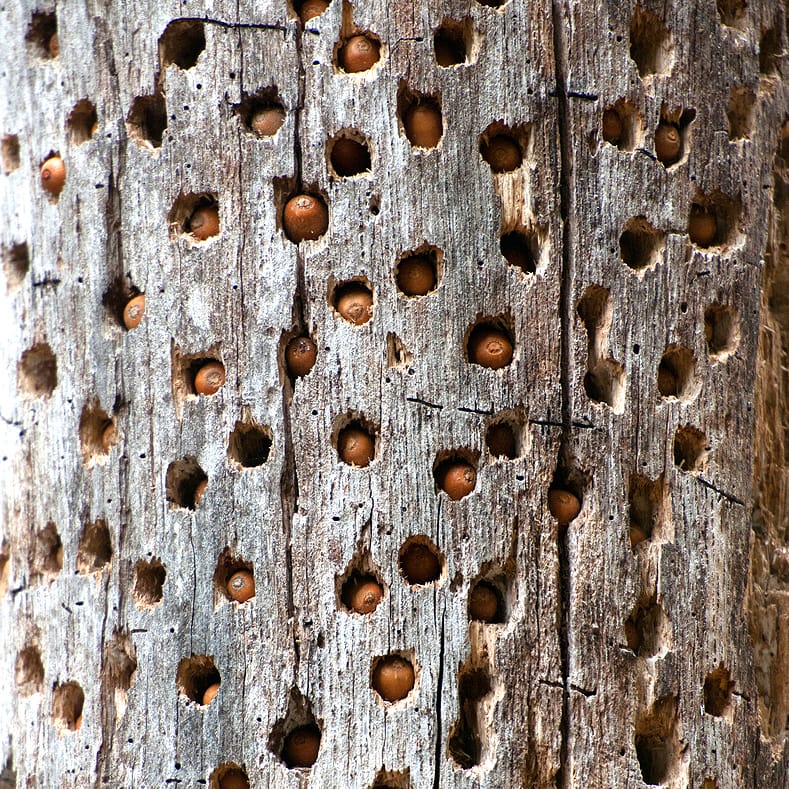
Long ago as settler colonialism crept west, and up the slopes of what would come to be known as the Sierra, unspeakable acts of violence occurred when those settlers came across people already living where the settlers wanted to live, or near where where they wanted to live, or where they might want to pass through at some time or some day in a future not yet determined.
Their grisly solution was to capture the residents and many were then put to death. Trees, old wiry trees, young trees, wind warped and lightning split trees, all were enlisted as backdrops for executions by gun. Over time, the scarification of bear claws and burrowing bugs gave way to bullet holes marking sharp moments, small gasps, and final exhalations.
The news spread to the woodpecker community but many thought it wasn’t appropriate to intervene. They had heard the stories of bison carried on the wind. Many were loath to intercede. In those days they weren’t known as woodpeckers, for they hawked insects from the air and deftly plucked acorns when ripe. There was no need to store their food in caches. They migrated and followed the summer, followed the food, followed the light.
In time, the atrocities could not be borne by those of such fine wing and hollow bone. A decision was made and the birds went to work. Each night they would quietly rise and carry acorns aloft, alighting gently on the roofs and eaves of the settler structures. They sought out the guns. They plugged the barrels. They left like apparitions.
They were diligent. When the sun was high they would slip into the wagons and storehouses and artfully fill the barrels, being careful to be quiet. Taking care to leave no trace.
The killings continued at pace with untouched guns which lived on the bodies and under the bedding of those who brought such harm. Eventually the birds, emboldened by the red remains, drawn by a color they wore, attending to sights they could not forget, the birds filled every last firearm.
The next time a young person was placed against a tree and a trigger pulled, the gun, over pressurized by a blockaded barrel, exploded, killing the aggressor and allowing the young one to escape into the cold, dappled, darkness under the boughs near the creek.
This happened again, and again, in different ways, with different shouts, under azure skies that delivered rafts of butterflies on the wind. It happened in rain, the creek pregnant with fish, and in the bright blue chill of a heavy snowfall. The people escaped, the settlers were disfigured or rendered still.
The reputation of these woods grew and the birds did not cease their work. The settlers began to give the area a wide berth as tales of death and mutilation spread outward with the urgency of a slow wind on long grass.
Soon the area was entirely free. The residents honored the care and heroism of the bird people. The birds were not often seen. Their dedication to secrecy had become ingrained and they were burdened by the weight of their actions. A deep need to clear the woods of the echoes of loss began to form. They began to methodically fill each bullet hole with an acorn, attempting to repair history.
This took time. Generations rose and fell before the forest had been healed through each beak and bird making their symbolic gesture. The birds did not know another way to live. They had lost the old knowledge. They no longer chased the summer southward. The rhythms of time and the brevity of their lifespans meant they had even lost the reasons for their movements. They filed holes automatically. In lean times they would return to eat from their makeshift granaries. When all holes were filled they dug new ones. They did not understand why. They were woodpeckers now. The losses and the fight had broken them.
They still dig holes and they still fill them, and they dig holes and they fill them. The trees now bear the scars. Every so often you stumble across one of the original trees, wiry, preserved like bone by the dry mountain air. Some of them still stand. Some of them sing in the wind and shout when hit by lightning. Some of them remember.
*written as an example for students of my course on engaging with the impossible. the prompt was to find an artifact in the forest and write an alternate history that explains its presence.